
Close coverage gaps
Coverage shows capabilities by source or scope, with a status, evidence detail, suggested next step and evaluation time. Use it before claiming an organization or repository was assessed.
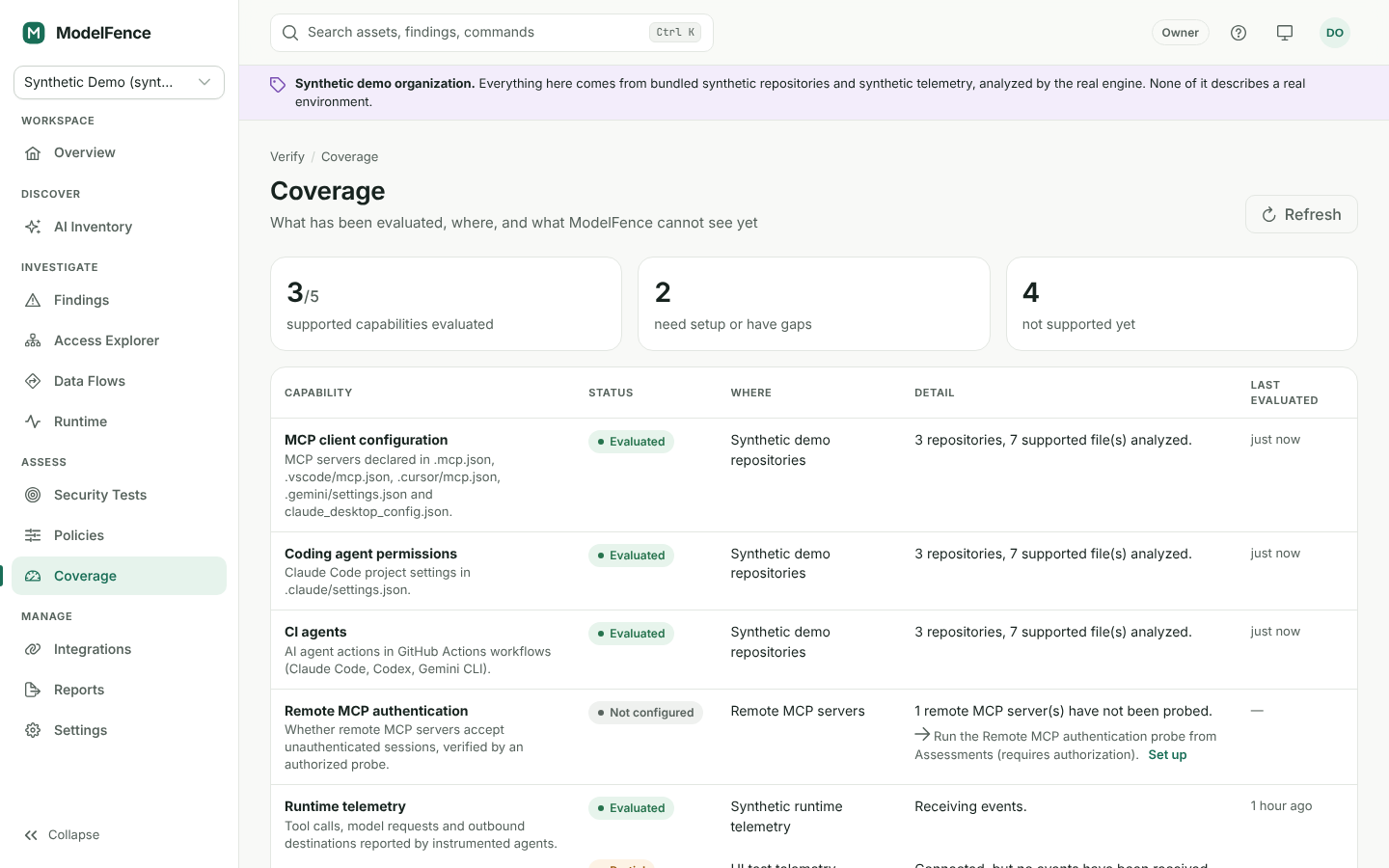
Synthetic demo data. Review your own source-level status and evaluation time before drawing a conclusion.
Read the summary
Section titled “Read the summary”The header reports how many supported capabilities are fully evaluated. A partial or outdated capability is not counted as fully evaluated. Unsupported capabilities are displayed separately so they cannot make the denominator look artificially complete.
Source configuration evaluations become outdated after the application’s freshness threshold, currently seven days. Runtime telemetry uses a shorter freshness window, currently one day without events. These labels are operational signals; the right review interval for your organization may be shorter.
Work from the gap
Section titled “Work from the gap”| You see | Next step |
|---|---|
| No source connected | Connect GitHub in Integrations. |
| Connected, not scanned | Run discovery or the relevant passive assessment. |
| Permission denied | Correct installation or repository access, then rerun. |
| Partial | Read the gap detail, fix that prerequisite, and repeat the evaluation. |
| Outdated | Verify the source is healthy and collect current evidence. |
| No runtime telemetry | Create an integration and instrument a sender. |
| Remote server not probed | Review scope and authorization in the assessment wizard. |
| Unsupported | Use another review method; no ModelFence test has established a result. |
Keep scope with the decision
Section titled “Keep scope with the decision”When reporting findings or a remediation, include the organization, source run and evaluation time. An asset with no findings but missing runtime telemetry has a different evidence boundary from one with both repository analysis and current observed activity.
Coverage is a statement about available evidence, not a compliance certification, security rating or guarantee that all AI services have been discovered.